
Income Tax on Influencer Earnings in India (2026): TDS Rates, the 0.1% Rule & How to Claim It Back
By CloutROI Team
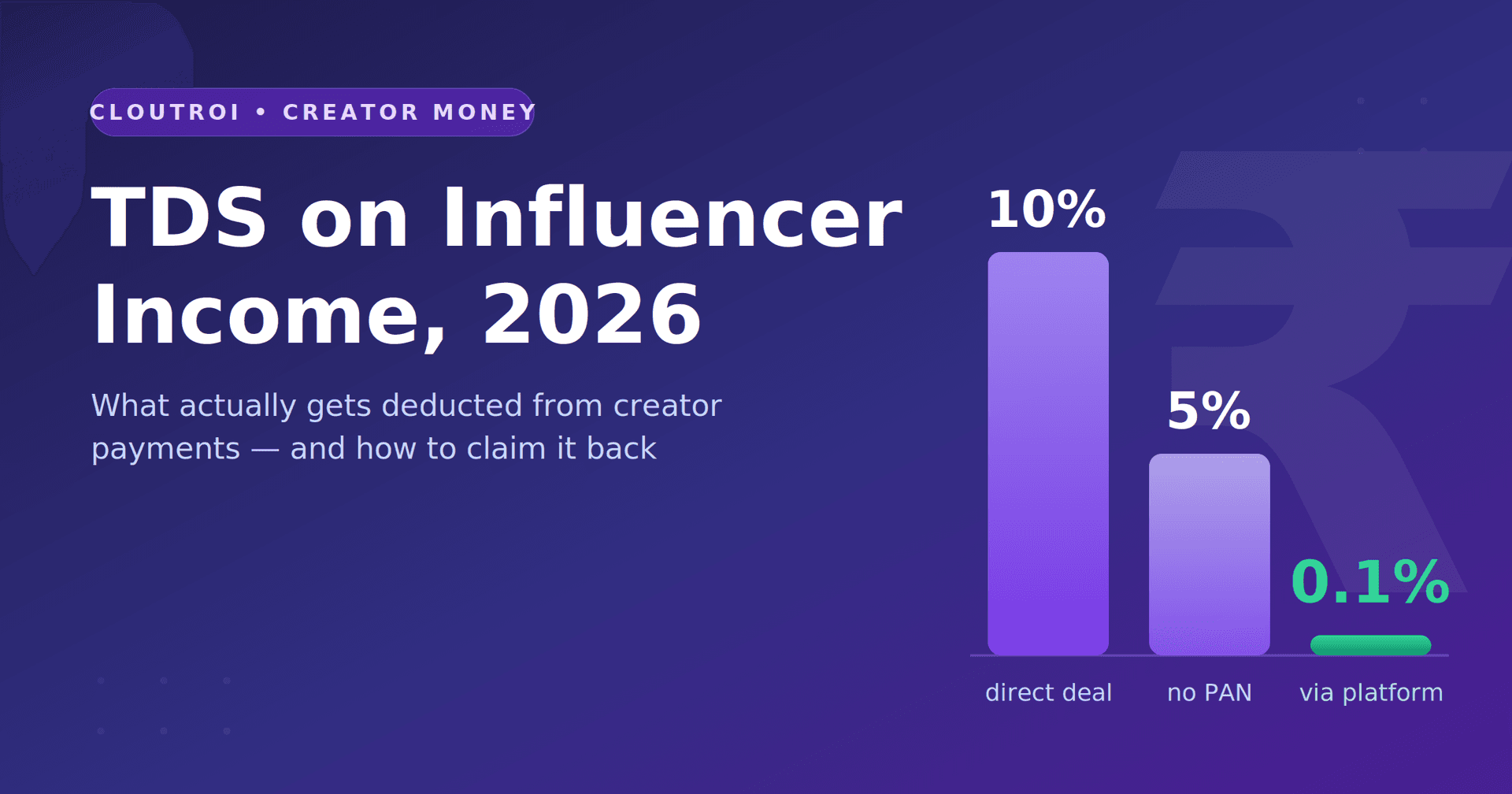
You did two brand deals last month. Both paid ₹10,000. One brand transferred ₹9,000 — the other, ₹9,990.
Neither brand cheated you. They applied two different sections of Indian tax law — and once you understand how tax on influencer income actually works in India, and which section applies to which kind of deal, every deduction on every payment you receive will make sense. You'll also know exactly how to claim it back.
This guide covers what actually gets deducted from creator income in India in 2026, in plain language. (One note before we start: this is educational content, not tax advice — for your specific situation, talk to a CA.)
First, the big picture: TDS is not a tax on you — it's a prepayment
TDS (Tax Deducted at Source) is money withheld from your payment and deposited with the government against your PAN. It's not an extra tax and it's not gone. When you file your income tax return, every rupee of TDS deducted during the year is credited to you — it either reduces the tax you owe or comes back as a refund.
The catch: this only works if the deduction is linked to your PAN. Hold that thought — it's the single most important fact in this article.
The three sections that hit creator income
Different deal structures trigger different TDS sections. Here's the map:
1. Deals through a marketplace or platform — Section 194-O, just 0.1%
If you get paid through an online platform — an influencer marketplace, a creator platform, any "e-commerce operator" that connects you with brands and processes the payment — the platform deducts TDS under Section 194-O, and the rate is 0.1% of the gross deal value.
Yes, 0.1%. On a ₹10,000 deal, that's ₹10.
This surprises many creators because most articles about influencer tax only mention the 10% rate. But the law changed on 1 October 2024, when the 194-O rate was cut from 1% to 0.1% — and it stays 0.1% under the new Income-tax Act, 2025 (where the same rule now lives as Section 393, if you enjoy reading tax law; everyone still calls it 194-O).
Even better: 194-O overrides the other sections. If a payment is covered by 194-O, the brand cannot also deduct under 194J or 194C. One deal, one deduction, 0.1%.
2. Direct deals with a brand — Section 194J, usually 10%
If a brand or agency pays you directly — no platform in between — your work counts as professional/technical services, and the brand deducts 10% under Section 194J once your payments from them cross the annual threshold (₹50,000 in a financial year).
Same ₹10,000 deal, done directly: ₹1,000 deducted instead of ₹10.
Some direct arrangements are structured as contracts rather than professional services, which triggers Section 194C at 1–2% instead — but for a typical sponsored post or Reel, 194J at 10% is what most brands apply.
That's the answer to the mystery at the top of this article. The ₹9,000 payment was a direct deal (194J, 10%). The ₹9,990 payment came through a platform (194-O, 0.1%). Both deductions land against your PAN, and both come back to you at ITR time if your final tax works out lower.
3. Freebies and barter deals — Section 194R, 10% on stuff too
That smartphone a brand sent you to review and keep? If the total value of such benefits from a business crosses ₹20,000 in a financial year, the brand must deduct 10% TDS on the fair market value under Section 194R — even though no cash changed hands. A ₹30,000 phone means ₹3,000 of TDS, and the phone's value counts as your taxable income.
If you return the product after the review, it generally isn't a taxable benefit. If you keep it, it is.
The ₹5 lakh exemption most creators qualify for
Here's the part of 194-O that almost nobody writes about: if you're an individual (or HUF) and your gross sales through a platform stay at or below ₹5,00,000 in the financial year, and you've furnished your PAN or Aadhaar, the platform isn't required to deduct any TDS at all.
Most nano and micro creators earning through platforms fall under this ceiling, especially early on. Two practical notes:
- Some platforms deduct 0.1% from the first rupee anyway, because tracking every creator's running total is operationally harder than uniform deduction. That's legal — over-deduction is always allowed — and you reclaim it in your ITR. At 0.1%, we're talking about ₹500 on ₹5 lakh of income, fully recoverable.
- The exemption (and the 0.1% rate itself) depends on the next section, which is the one thing you should act on today.
No PAN = 5% deducted, and you probably can't get it back
If you haven't furnished your PAN, the law doesn't let a platform deduct 0.1%. The mandatory rate jumps to 5% — fifty times higher.
And it gets worse. TDS deducted without a PAN can't be mapped to you in the tax system. It shows up in the deductor's filings as "PAN not available," which means it never appears in your Form 26AS, and you cannot claim the credit back when you file your return. That 5% isn't a prepayment anymore — it's effectively lost money.
This is why serious platforms ask for your PAN before your first paid deal. It's not bureaucracy; it's the difference between ₹10 deducted-and-recoverable and ₹500 deducted-and-gone on the same ₹10,000 deal.
Action item: whichever platforms or brands you work with, make sure your PAN is on file before money moves. It takes two minutes.
How to actually get your TDS back
Every rupee deducted against your PAN follows a paper trail you can check:
- Form 26AS / AIS — log in to the income tax portal and check these statements. Every TDS deposit made against your PAN appears here, with the deductor's name. Do this once a quarter; if a deduction is missing, chase the brand/platform.
- Form 16A — deductors issue this quarterly TDS certificate to you. Match it against 26AS.
- File your ITR — creator income is "Profits and Gains from Business or Profession." Most creators file ITR-3, or ITR-4 if you opt for presumptive taxation under Section 44ADA (declare 50% of gross receipts as profit, skip detailed bookkeeping — available to professionals with receipts up to ₹75 lakh, subject to conditions). Your total TDS from 26AS gets credited against your final tax bill. Owe less than what was deducted? The difference is refunded to your bank account.
One more thing while you're at it: if your total tax liability for the year exceeds ₹10,000, you're supposed to pay advance tax in quarterly instalments — TDS at 0.1% won't cover your actual slab-rate liability, so set aside a percentage of every payout.
Quick answers
Why was only 0.1% TDS deducted from my platform payment? Because Section 194-O applies to payments through e-commerce operators, and the rate has been 0.1% since 1 October 2024. It's correct, not a mistake.
Why did a brand deduct 10% when platforms deduct 0.1%? Direct deals fall under Section 194J (professional services, 10%). Platform deals fall under 194-O (0.1%), which overrides 194J. Same work, different payment route, different section.
Is TDS extra tax I'm losing? No — it's prepaid tax credited to your PAN. You claim it when filing your ITR. The only unrecoverable case is deduction without a PAN on file.
I earn less than ₹5 lakh a year through platforms. Why is TDS still deducted? Platforms may deduct uniformly from the first rupee for operational simplicity. It's 0.1%, it's legal, and you reclaim it in your return.
Do I need GST registration too? Separate question, separate law — GST registration becomes mandatory only when your aggregate turnover crosses ₹20 lakh (₹10 lakh in special category states). We've covered it in detail in our GST guide for creators.
CloutROI is an escrow-backed marketplace where Indian brands and creators run paid collaborations with the money secured before work begins. Tax deductions on the platform follow Section 194-O, and your statement shows every rupee — gross, deductions, and net — for every deal.
This article is for general information only and is not tax, legal, or professional advice. Tax law changes; consult a chartered accountant for advice on your specific circumstances.