
GST Registration for Influencers in India (2026): Do You Need It Under ₹20 Lakh?
By CloutROI Team
Every creator community has this moment: someone lands their first decent brand deal, posts about it, and three people immediately reply "bro, you need GST registration or you'll get a notice."
Most of the time, that advice is wrong — and following it early can saddle you with years of unnecessary monthly compliance. Here's what the law actually says in 2026, in plain language. (Educational content, not tax advice — for your specific situation, talk to a CA. And if you're looking for the income tax side — the TDS deducted from your payments — that's a different law entirely; we've covered it in our TDS guide for creators.)
The one number that decides everything: ₹20 lakh
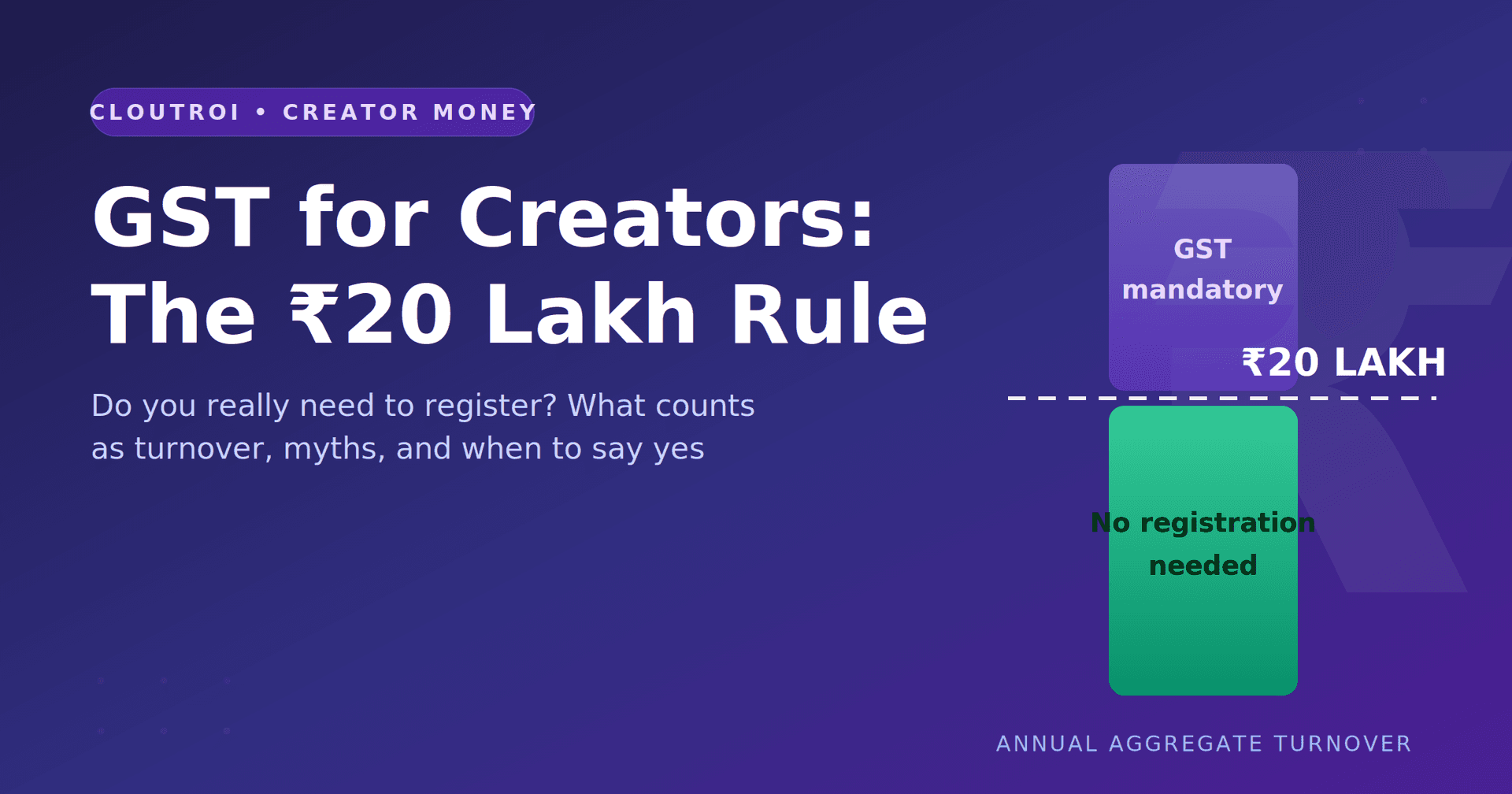
GST registration becomes mandatory only when your aggregate turnover crosses ₹20 lakh in a financial year (₹10 lakh if you're in a special category state, mostly in the North-East).
Below that line, as a service provider, you are not required to register, not required to charge GST on your invoices, and not required to file GST returns. A brand paying you ₹40,000 for a Reel doesn't trigger anything. Neither does ₹4 lakh a year. Neither does ₹19 lakh.
The confusion exists because the rules for goods are stricter, and half the advice floating around creator groups is borrowed from sellers, not service providers. Influencer work — sponsored posts, brand promotions, UGC — is a supply of services in GST law, and services get the cleaner treatment.
What counts toward the ₹20 lakh (this is where people get surprised)
"Aggregate turnover" is wider than your brand-deal income. It includes essentially everything you earn from your creator work, added together:
- Brand collaborations and sponsorships — the obvious one.
- Platform ad revenue — YouTube/AdSense payouts count toward the total, even though (as exports of service) they may ultimately attract zero GST.
- Affiliate commissions — Amazon links, referral programs, all of it.
- Merchandise and digital product sales.
- Barter deals, at market value. This is the one that genuinely surprises people: that ₹30,000 phone you promoted and kept isn't free in GST math — its fair market value counts as turnover, because GST law treats barter as a supply like any other.
So the correct self-check isn't "did brands pay me ₹20 lakh in cash" — it's "did everything I earned from creating, in cash and kind, cross ₹20 lakh." Track the total from day one; the day you cross, the registration clock starts (you have 30 days).
Two myths that push creators into registering too early
Myth 1: "You work with brands in other states, so you must register." For goods, inter-state supply does force registration regardless of turnover. For services, it doesn't — service providers below ₹20 lakh are exempt from compulsory registration even when their clients are in other states. A Jaipur creator invoicing a Bengaluru brand stays exempt under the threshold.
Myth 2: "You earn through an online platform, so you must register." There is a rule that forces anyone selling goods through e-commerce platforms to register from the first rupee — and it gets misapplied to creators constantly. But the government specifically exempted service providers supplying through platforms from compulsory registration as long as they're under the threshold (Notification 65/2017). A creator earning through a marketplace, under ₹20 lakh, does not need GST registration. Related bonus: the GST TCS that platforms collect (0.5%) applies only to registered suppliers — so as an unregistered creator under the threshold, there's no GST-side deduction from your platform payouts either.
Should you register voluntarily before ₹20 lakh?
Sometimes yes — but go in with open eyes, because voluntary registration is a one-way door into real compliance work.
Reasons to consider it:
- Big-brand procurement. Some large advertisers and agencies prefer (occasionally insist on) GST-registered vendors so they can claim input credit on your invoice. If your pipeline is heading corporate, a GSTIN removes friction.
- Input Tax Credit. Once registered, the 18% GST you pay on cameras, editing software, phone bills and other business inputs becomes credit against the GST you collect — a genuine saving if your equipment spend is heavy.
- Signal of scale. A GSTIN on your invoice reads as "established business," which occasionally matters in negotiations.
The costs, honestly:
- You must charge 18% on every invoice from then on — making you 18% pricier to unregistered or non-creditable clients, or 18% poorer if you absorb it.
- Returns forever — GSTR-1 and GSTR-3B on a monthly or quarterly cycle, filed even in zero-income months, with late fees for misses. For most creators this means paying a CA a monthly retainer.
- No casual exit. Deregistering is possible but bureaucratic; don't register "just to be safe."
The practical rule most CAs give creators: stay unregistered until the threshold forces you or a major client does — and put your energy into tracking your running turnover so the crossing never catches you by surprise.
Crossed ₹20 lakh? Here's your new life in one paragraph
Register within 30 days. Your services are taxed at 18% (SAC 9983 territory), which you add to every invoice — so a ₹50,000 deal becomes ₹59,000 billed, with ₹9,000 collected for the government. You file GSTR-1 (invoices out) and GSTR-3B (summary + payment) monthly or quarterly, claim ITC on business purchases, and pay GST on foreign software subscriptions under reverse charge (also claimable as ITC). If part of your income is from foreign platforms or overseas clients, those are zero-rated exports — file a Letter of Undertaking (LUT) so you don't charge GST on them while still claiming credits. And on marketplaces, expect the platform to collect 0.5% TCS on your supplies, which lands in your GST cash ledger — not a cost, just a prepayment you offset.
Quick answers
I earn ₹8 lakh a year from brand deals. GST registration? Not required. Track your total (including barter and ad revenue) and revisit when you approach ₹20 lakh.
A brand is asking for my GSTIN and I don't have one. Am I doing something wrong? No. Under ₹20 lakh you're legally unregistered; tell them so. Some corporates will proceed happily; a few insist on registered vendors — that's a commercial choice for you, not a legal obligation.
Do freebies really count toward ₹20 lakh? Yes — barter is a supply at fair market value. (They're also taxable income with their own TDS treatment — see the 194R section of our TDS guide.)
Is GST the same as the tax deducted from my payments? No. TDS is income tax withheld against your PAN and recoverable in your ITR. GST is an indirect tax on your services that only concerns you once registered. Different laws, different registrations, different returns.
₹20 lakh in one deal — what happens? Same rule: cross the threshold, register within 30 days, charge GST prospectively from registration. Get a CA involved that week, not that quarter.
CloutROI is an escrow-backed marketplace where Indian brands and creators run paid collaborations — your billing statement tracks every deal's gross, deductions and net, which makes watching your running turnover (and your CA's life) considerably easier.
This article is for general information only and is not tax, legal, or professional advice. GST law and notifications change; consult a chartered accountant for advice on your specific circumstances.