
Nano vs Micro Influencers in India (2026): Rates, ROI, and When to Use Each
By CloutROI Team
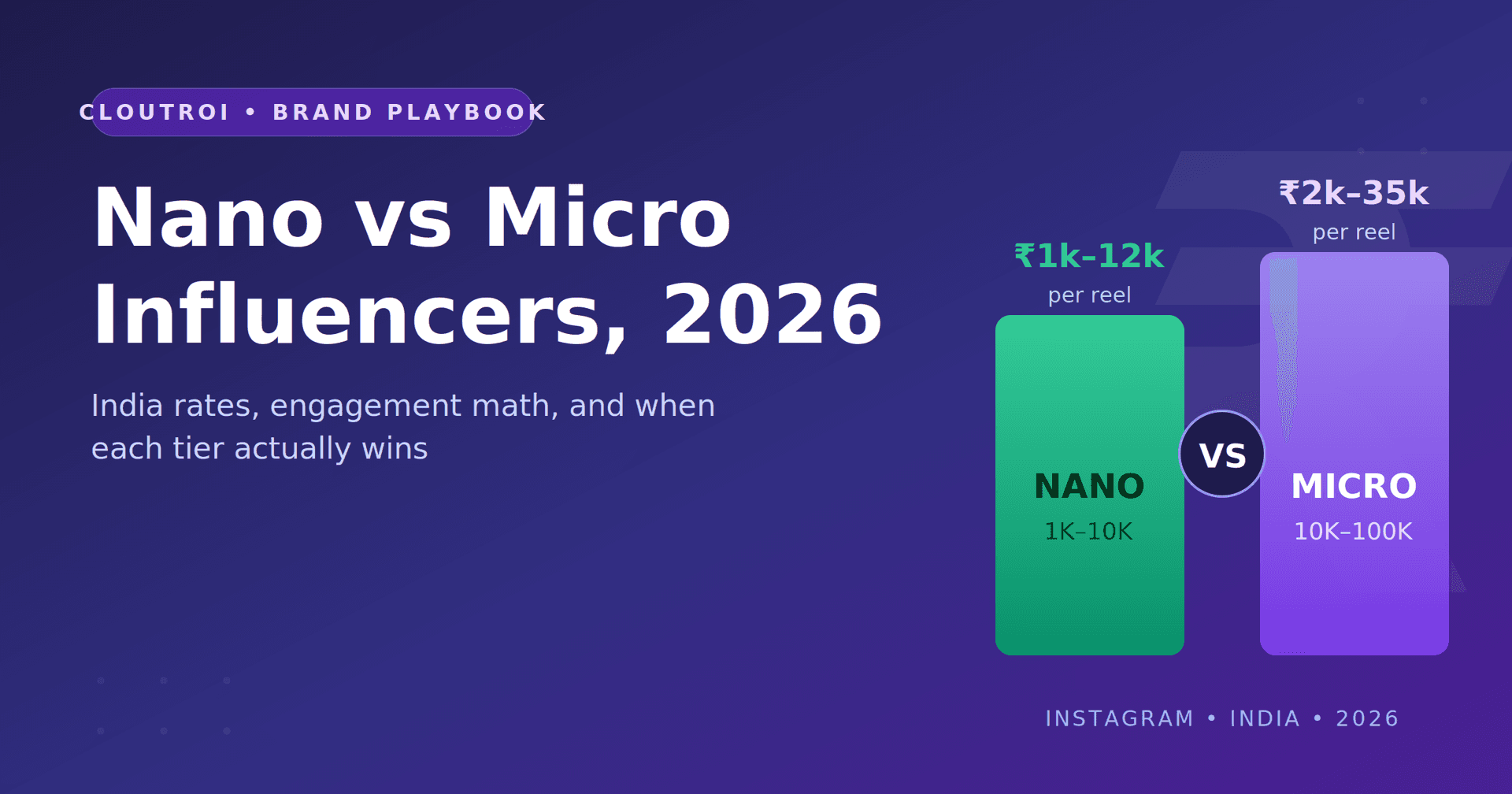
Every brand planning its first creator campaign hits the same fork: work with a handful of micro influencers, or a bigger swarm of nano creators? The tiers sound interchangeable — both are "small influencers" — but they behave differently, price differently, and win in different situations. Choosing wrong doesn't blow up your campaign; it just quietly halves your return.
Here's the practical comparison for India in 2026: what each tier costs, what each is actually good at, and a decision framework you can apply to your next brief in five minutes.
The definitions (so we're talking about the same people)
- Nano influencers: roughly 1,000–10,000 followers. Students, homemakers, working professionals with a genuine local or hobby audience. Content is unpolished by design — and that's the appeal.
- Micro influencers: roughly 10,000–100,000 followers. Semi-professional or professional creators, usually with a defined niche (skincare, personal finance, home cooking, tech), consistent posting, and noticeably better production.
Above them sit mid-tier, macro and celebrity tiers — a different budget universe that we've covered in our influencer pricing guide.
How much do nano and micro influencers charge in India?
Indicative 2026 market ranges for Instagram, the platform where most Indian brand deals happen (for every tier plus YouTube, see our influencer rate card for India):
| Deliverable | Nano (1K–10K) | Micro (10K–100K) |
|---|---|---|
| Reel | ₹1,000 – ₹12,000 | ₹8,000 – ₹80,000 |
| Static post / carousel | ₹800 – ₹9,000 | ₹6,000 – ₹60,000 |
| Story (per story) | ₹400 – ₹5,000 | ₹3,200 – ₹32,000 |
Why the wide ranges? Two levers move price more than follower count does:
- Niche. Finance and tech creators command 30–50% premiums over lifestyle and food, because their audiences make expensive decisions. A 9,000-follower finance nano can out-price a 40,000-follower lifestyle micro.
- Engagement quality. Real comments, saves and shares justify the top of a range; a big-but-passive audience belongs at the bottom of it, whatever the follower count says.
And three pricing mechanics that apply to both tiers: bundles (3 Reels + Stories) typically come 20–35% cheaper than buying deliverables individually; usage rights to reuse content in your own ads add 30–150%; and exclusivity (asking a creator to avoid your competitors for a period) is a real cost to them and typically adds 20–50%. Negotiate all three at booking, never after the content performs.
The engagement math: why smaller keeps winning
Industry benchmarks are remarkably consistent on this: nano creators average roughly 4–5% engagement per post, micros around 3–4%, and the rate keeps falling as accounts grow — often near 1% at mega scale. Followers of small accounts actually know the creator; that familiarity is the entire mechanism of influence.
Run the arithmetic on a ₹30,000 budget:
- Ten nano creators at ₹3,000 each ≈ 50,000 combined followers × ~4.5% engagement ≈ 2,250 genuine interactions, spread across ten independent communities — plus ten pieces of content and ten data points about what works.
- One micro creator at ₹30,000 ≈ 80,000 followers × ~3.5% ≈ 2,800 interactions — slightly more raw engagement, from one community, in one creator's style, with single-point-of-failure risk.
Close on paper. The difference is what kind of attention you're buying — which is the real decision.
When nano influencers win
- Hyper-local campaigns. Launching in specific cities or tier-2/3 towns, where a neighbourhood creator's recommendation reads like word-of-mouth. This is the tactic FMCG giants use for regional launches — we broke down their full approach in the FMCG nano/micro playbook.
- Trust-heavy, low-ticket products. Snacks, personal care, apps, local services — impulse or habit purchases where relatability beats authority.
- Regional language audiences. The fastest-growing slice of Indian internet, and almost exclusively nano/micro territory.
- UGC volume. Ten nanos produce ten authentic videos you can (with usage rights) repurpose in performance ads — often cheaper than a production house shoot.
- Testing budgets under ₹25,000. Nano swarms are the cheapest real-world experiment in marketing.
The trade-offs: more coordination (ten briefs, ten follow-ups, ten payments), inconsistent production quality, and occasional unprofessionalism — some nanos have never done a brand deal before. Written deliverables and delivery-linked payment aren't optional at this tier; they're the operating system.
When micro influencers win
- Niche authority products. Skincare actives, financial products, gadgets, courses — anything where the audience asks "does this person actually know their subject?" A micro's credibility in their vertical is the product's credibility.
- Higher-ticket items. Longer consideration cycles need a creator whose recommendation carries weight beyond familiarity.
- Content you plan to reuse. Micro production quality usually survives being turned into an ad; nano content sometimes doesn't.
- Fewer moving parts. Three micros are operationally lighter than twelve nanos — relevant if you're a one-person marketing team.
- Bridging to scale. Micros are the audition pool for long-term ambassadors; the ones who convert get retainers.
The trade-offs: single points of failure, higher per-post stakes, and rate cards that increasingly resemble small agencies' — negotiate on engagement data, not follower count.
The honest answer: most good campaigns use both
The pattern that keeps winning across Indian FMCG, D2C and local-services campaigns is a pyramid roster: a base of nano creators generating swarm visibility and UGC, with one or two micros on top providing the credible, polished anchor content in the same window. The micro post makes the brand look established; the nano swarm makes it look everywhere. On a ₹50,000 budget that might be eight nanos (₹24,000) plus one strong micro (₹20,000), with ₹6,000 held back to re-book whoever performs.
Whichever mix you choose, the selection rules are identical: read the last 15–20 posts for comment quality, distrust sudden follower spikes, prefer exact-niche small over adjacent-niche big — and measure with unique codes or links so the next campaign is built on data instead of vibes.
Quick answers
How much does a nano influencer charge in India? Typically ₹1,000–₹12,000 per Instagram Reel in 2026, with finance/tech niches at the top of the range and many nanos open to product-plus-cash arrangements. On the creator side of that negotiation? Our guide to becoming a paid influencer covers setting your first rate and getting deal-ready.
Are micro influencers worth the higher price? When niche authority matters to the purchase — yes, and their content usually carries reuse value nano content doesn't. For pure awareness of low-ticket products, a nano swarm often returns more per rupee.
How many followers is nano vs micro? Common Indian industry convention: nano 1K–10K, micro 10K–100K. Some agencies split micro at 50K; the behaviour patterns above matter more than the exact boundary.
What engagement rate should I expect? Around 4–5% for genuine nano accounts and 3–4% for micros. Materially below that for the tier, question the audience quality before booking.
CloutROI is an escrow-backed influencer marketplace for Indian SMBs — filter verified nano and micro creators by niche, city and engagement, agree deliverables in writing, and release payment only on delivery. Build your first roster without agency minimums.
Rate ranges are indicative 2026 market figures and vary by niche, engagement, format and negotiation.