Regional Language Influencer Marketing in India: The Arbitrage Most Brands Are Missing
By CloutROI Team
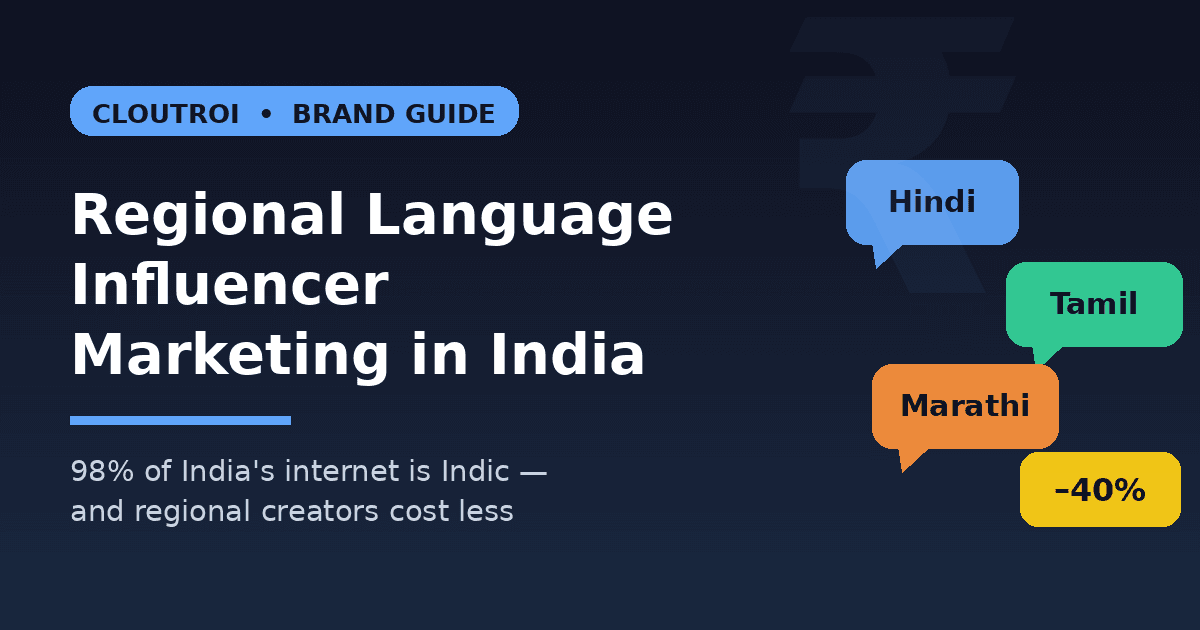
Here is a gap that should not exist in an efficient market. 98% of India's internet users access content in Indic languages, according to IAMAI and Kantar's Internet in India Report 2024. Yet regional creators with comparable reach are reported to earn 30–40% less than their metro counterparts, while delivering lower cost per click.
Comparable reach. Reportedly lower cost per click. Thirty to forty percent cheaper. That is not a market finding its price — that is an arbitrage, and it exists because most brands still brief in English and shortlist from Mumbai, Delhi and Bengaluru.
This post is about how to use that gap if you are a brand, and how to close it if you are a creator being paid on the wrong side of it.
The demand side: where India's internet actually is
The numbers that matter, all from IAMAI and Kantar's 2024 report:
- 886 million active internet users, growing 8% year on year
- 98% accessed content in Indic languages
- 488 million users are rural — 55% of the total
- 57% of urban internet users prefer regional-language content
- Tamil, Telugu and Malayalam are named the most popular, attributed to the depth of content available in them
Read the fourth point again. This is not a rural-versus-urban story. A majority of urban Indian internet users prefer content in a regional language. A brand running English-only creator campaigns in Pune, Hyderabad or Kochi is not reaching a metro audience efficiently — it is reaching the slice of that metro audience that prefers English.
The platform picture follows the same shape. Short-video platforms Moj and ShareChat report that 75–80% of their creators come from Tier 2 and Tier 3 regions. That is where the supply is, and increasingly where the attention is.
The brief side: brands are already moving
Agencies report the shift clearly, though the exact numbers vary by who you ask. Across several Indian influencer marketing firms quoted in trade press during 2025, 30–45% of national campaign briefs now carry a regional creator requirement, and one agency reported vernacular briefs rising 40–45% over a 12–18 month period.
Treat these as directional agency estimates rather than measured industry data — they come from individual firms describing their own brief flow, and the figures disagree with each other by a wide margin. The direction, however, is consistent across every source: regional mandates are becoming standard in national campaigns rather than a specialist add-on.
The price side: the gap itself
This is the part brands should act on.
A regional creator with 300,000-plus followers is reported to earn 30–40% less than a metro creator with comparable reach. One agency founder gave a concrete illustration: a metro lifestyle creator with 100,000 followers might quote around ₹30,000 per reel, while a regional creator with similar metrics is often offered ₹18,000–20,000.
The same agency sources report regional creators delivering 20–30% lower cost per click alongside strong engagement.
Two honesty notes, because this is exactly the kind of claim that gets repeated into fiction. The rate example is one founder's illustration, not a survey. And a widely circulated claim that regional influencers have "40% higher engagement than metro peers" appears in trade coverage without any named study behind it — we would not put that number in a budget deck. The defensible version of the claim is narrower and still compelling: regional creators are cheaper for comparable reach, and the agencies buying them report better cost efficiency.
Why might the gap persist? Our read is three habits rather than any economic reason — an interpretation, not a finding from the sources above:
Discovery is English-first. Most brand teams search in English, and most creator platforms are built around English-language discovery. A Marathi creator in Nashik is not hidden — she is simply not surfaced by the way brands look.
Rate anchoring. Regional creators often price against what other regional creators charge rather than against the reach they deliver, and brands are happy to accept that anchor.
Metro proximity bias. Marketing teams sitting in Mumbai and Bengaluru shortlist creators they have seen, and they see metro creators.
None of these is an efficiency. They are all habits, and habits are what arbitrage feeds on.
How brands should actually run regional campaigns
Knowing the gap exists is not the same as using it well. Four things separate campaigns that work from campaigns that translate.
Do not translate the brief. Rebrief it. A Hindi script that is an English script converted word for word reads as an advertisement in every language. Give regional creators the message and the non-negotiables, then let them write it in how their audience actually speaks — including the code-switching that is how most urban Indians talk anyway.
Match the language to the market, not the map. Language and geography are not the same thing. Mumbai is a Marathi, Hindi and Gujarati market simultaneously. Bengaluru is Kannada, Tamil, Telugu and English. Targeting "Karnataka" is not a language decision; choosing Kannada is.
Expect different content norms. Format, pacing, humour and product-demonstration conventions vary meaningfully across Indian language markets. A creator who knows their audience will deviate from your reference video — that deviation is usually the reason to hire them.
Measure per language, not in aggregate. Run the same offer across three languages with separate discount codes and you will frequently find one dramatically outperforming the others. That finding is worth more than the campaign itself, because it tells you where to put the next three budgets. Our guide to measuring influencer marketing ROI covers the attribution setup for this.
One more thing brands routinely get wrong: regional does not mean low-budget. The pricing gap is an opportunity to buy more reach per rupee, not permission to treat regional creators as a discount tier. Creators notice, and the ones worth hiring decline.
Which languages to start with
There is no universal answer — it depends entirely on where your customers are. But a practical sequencing most Indian D2C brands can use:
Hindi reaches the largest single audience, and is the usual first step beyond English. Be aware the Hindi belt is not one market; Delhi, Lucknow, Patna and Indore differ.
Tamil, Telugu and Malayalam are named by IAMAI and Kantar as the most popular Indic languages online, backed by unusually deep content ecosystems. Creator supply in these is strong.
Marathi, Bengali, Kannada and Gujarati make sense when your sales data shows concentration in those markets — which, for most D2C brands, it does somewhere.
Let your own order data pick, not this list. If 18% of your orders come from Tamil Nadu and you have never run a Tamil creator, that is where the next campaign goes.
For creators: you are probably underpriced
If you create in a regional language, the data above is about your rate card.
Price against your reach and engagement, not against other regional creators. The 30–40% gap exists partly because regional creators anchor to each other. Find out what a metro creator with your follower count and engagement charges, and ask why your number is lower. If the honest answer is "because that is what regional creators get," it is a market habit, not an economic fact.
Lead with your language as an advantage. Agencies report regional mandates in a growing share of national briefs, and those can be hard to fill. State the language, the specific market, and the audience you reach — not as a caveat, as a capability.
Offer multi-language packages. The same script in two or three languages is one of the most valuable things a bilingual creator can sell, because the alternative for the brand is hiring and briefing two separate people.
Make yourself findable in the right language. Put the language in your bio and in your profile's discovery fields. A brand with a Telugu brief cannot book you if nothing about your profile says Telugu.
For how to price concretely, see our India influencer rate card. For getting discovered and pitching, our guide to brand deals with a small following covers the mechanics.
On CloutROI, creating a free creator profile lets you publish your language, city and fixed package prices in one place — so a brand running a Marathi or Tamil brief can find you by the thing that makes you valuable rather than by follower count.
The bottom line
98% of India's internet runs on Indic languages. A majority of urban users prefer regional content. Regional creators with comparable reach are reported to cost 30–40% less and deliver better cost efficiency. Agencies say a third to nearly half of national briefs now require regional talent.
Brands: rebrief rather than translate, choose language rather than geography, measure per language, and do not treat the discount as the point. Creators: the gap is a pricing habit, not a valuation — price against your reach.
Gaps like this tend to narrow as more brands notice them, which is a good reason to test regional creators this quarter rather than next year.
Create a free brand account on CloutROI to filter Indian creators by language, city and niche, and see fixed package prices before you contact anyone.
Frequently asked questions
Do regional language influencers cost less in India?
Agency sources report that regional creators with comparable reach earn roughly 30–40% less than metro creators, with one illustrative example putting a metro creator at about ₹30,000 per reel against ₹18,000–20,000 for a regional creator with similar metrics. These are agency estimates rather than survey data, but the direction is consistently reported.
Which Indian languages should a brand start with for influencer marketing?
Let your order data decide. As a general sequence, Hindi reaches the largest single audience, while Tamil, Telugu and Malayalam are named by IAMAI and Kantar as the most popular Indic languages online with deep creator supply. Marathi, Bengali, Kannada and Gujarati follow where your sales concentrate.
Is regional language content only relevant for rural audiences?
No. IAMAI and Kantar found that about 57% of urban Indian internet users prefer regional-language content. Treating regional language as a rural-only strategy misreads where the audience is.
Should I translate my existing influencer brief into regional languages?
No. Translated scripts read as advertisements. Give the creator the core message and the non-negotiables, and let them write it in how their audience actually speaks, including natural code-switching between English and the regional language.
How do I measure which language performs best?
Run the same offer across languages with a separate discount code and UTM link per creator, keep the attribution window consistent, and compare cost per acquired customer per language rather than looking at the campaign in aggregate.
As a regional creator, how do I justify a higher rate?
Price against your reach and engagement rather than against what other regional creators charge. Bring evidence — recent view counts, saves, and audience location data — and state the specific market you reach. Regional mandates are a growing share of national briefs, which gives a well-evidenced regional creator room to negotiate.